
Advanced Materials and Manufacturing Technologies Laboratory, Department of Industrial Engineering and Management, School of Engineering, International Hellenic University, 57400 Thessaloniki, Greece

Manufacturing Technology and Production Systems Laboratory (MT-Lab), Department of Mechanical Engineering, School of Engineering, International Hellenic University, 62124 Serres, Greece

Digital Manufacturing and Materials Characterization Laboratory, School of Science and Technology, International Hellenic University, 57001 Thessaloniki, Greece
ACKNOWLEDGEMENTS
This research was funded by the grant titled “Optimization of 3D printed structures utilizing advanced materials, analytical techniques and experimental determination” (Grant No 82186), awarded by the Special Account for Research Funds of the International Hellenic University. It falls under task 2 of the program “Measures to Promote Research through Financial Support to Laboratories and Institutes of the International Hellenic University” (Code No. 80734).
PURPOSE
Investigation of the compressive mechanical response of dual-material honeycomb structures fabricated via Fused Filament Fabrication (FFF) using PLA and TPU.
The objective is to experimentally evaluate the influence of material distribution and interlocking geometry on global structural behavior under compression. Different configurations are examined, including teeth-based and tau interlocking designs, in order to quantify their effect on load transfer, deformation evolution, and failure modes.
The analysis focuses on identifying how design parameters affect:
- peak load capacity,
- collapse characteristics,
- structural integrity at large deformation levels.
METHODOLOGY
Dual-material honeycomb specimens (3×3 cells, L = 20 mm, t = 2 mm) were designed with different material distributions and interlocking geometries at the corners.
Four configurations were examined:
- TPU interlocking (4-teeth),
- TPU interlocking (3-teeth),
- PLA interlocking (4-teeth),
- TPU Tau interlocking (3-teeth).
Compression tests were carried out under quasi-static loading conditions (5 mm/min) up to ~95% strain.
Force–displacement data were recorded, and deformation evolution was monitored to assess collapse behavior and structural integrity.
Specimens were fabricated using Fused Filament Fabrication (FFF) with PLA as the rigid phase and TPU as the flexible phase, using 100% infill and a concentric pattern.
RESULTS – EXPERIMENTAL INVESTIGATION
All configurations exhibit the typical response of cellular structures, consisting of an initial elastic region, a collapse plateau, and a densification stage.
The PLA-corners configuration achieves the highest peak force. The placement of stiff PLA material at the nodal regions increases resistance to bending. Structural integrity is reduced beyond approximately 50% strain, followed by rapid degradation and unstable collapse.
The TPU-corners configurations show lower load-carrying capacity and improved deformation stability. The 3-teeth configuration performs better than the 4-teeth case, indicating more efficient load transfer and reduced sensitivity to local imperfections. The 4-teeth configuration exhibits increased damage and less stable deformation.
The TPU Tau interlocking configuration presents a distinct mechanical response. Peak force is lower compared to the PLA-corners case. The collapse regime is smoother and more stable. Structural integrity is maintained at large deformation levels. The deformation process is more uniform, with reduced fluctuations in the force–displacement response.
Densification occurs at similar displacement levels for all configurations. This indicates that the global geometry governs the onset of densification, while material distribution and interlocking design control the collapse behavior.
Specimen configurations
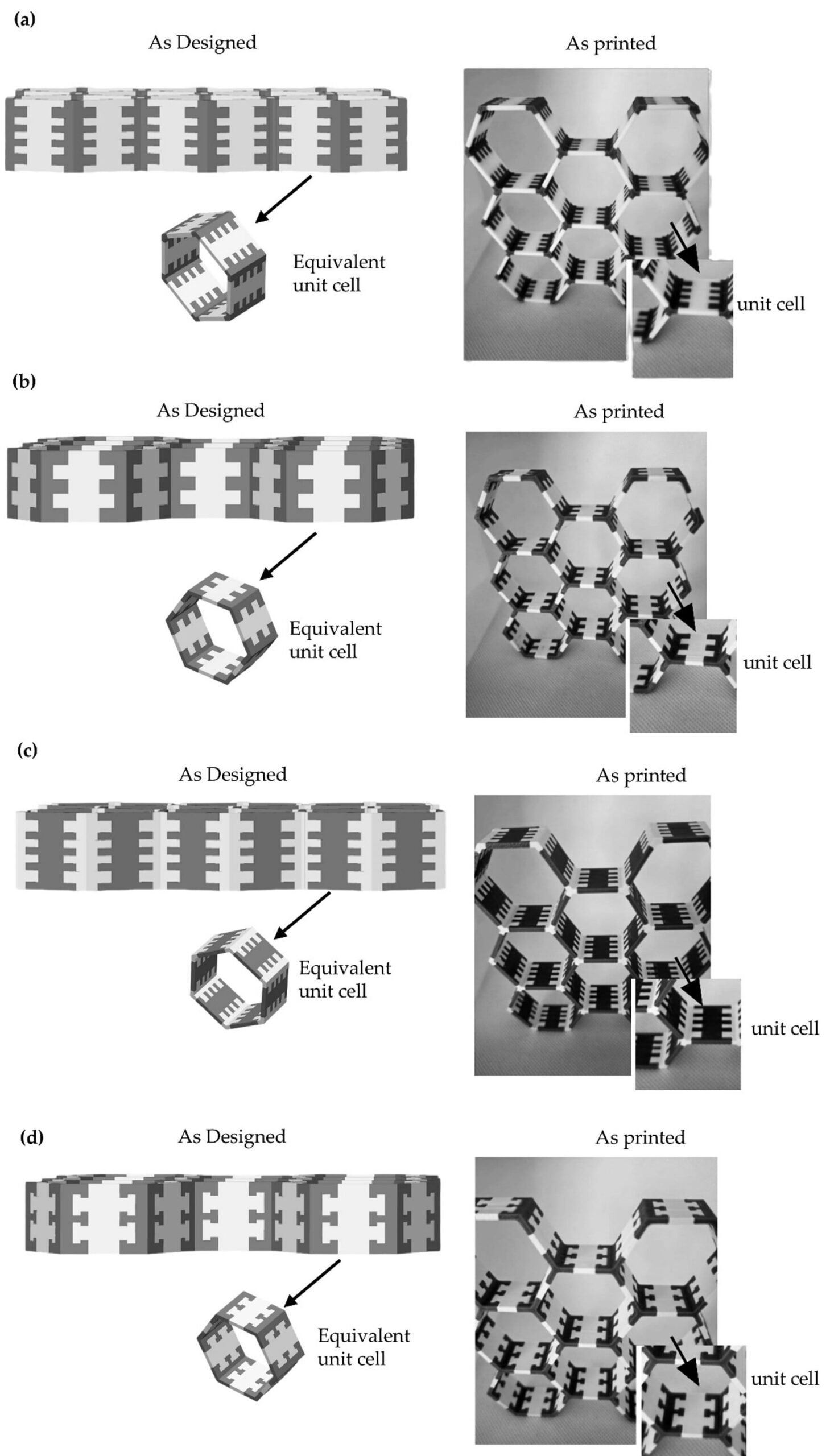
As-designed and as-printed dual-material honeycombs for the four configurations examined experimentally.
Experimental force-displacement response
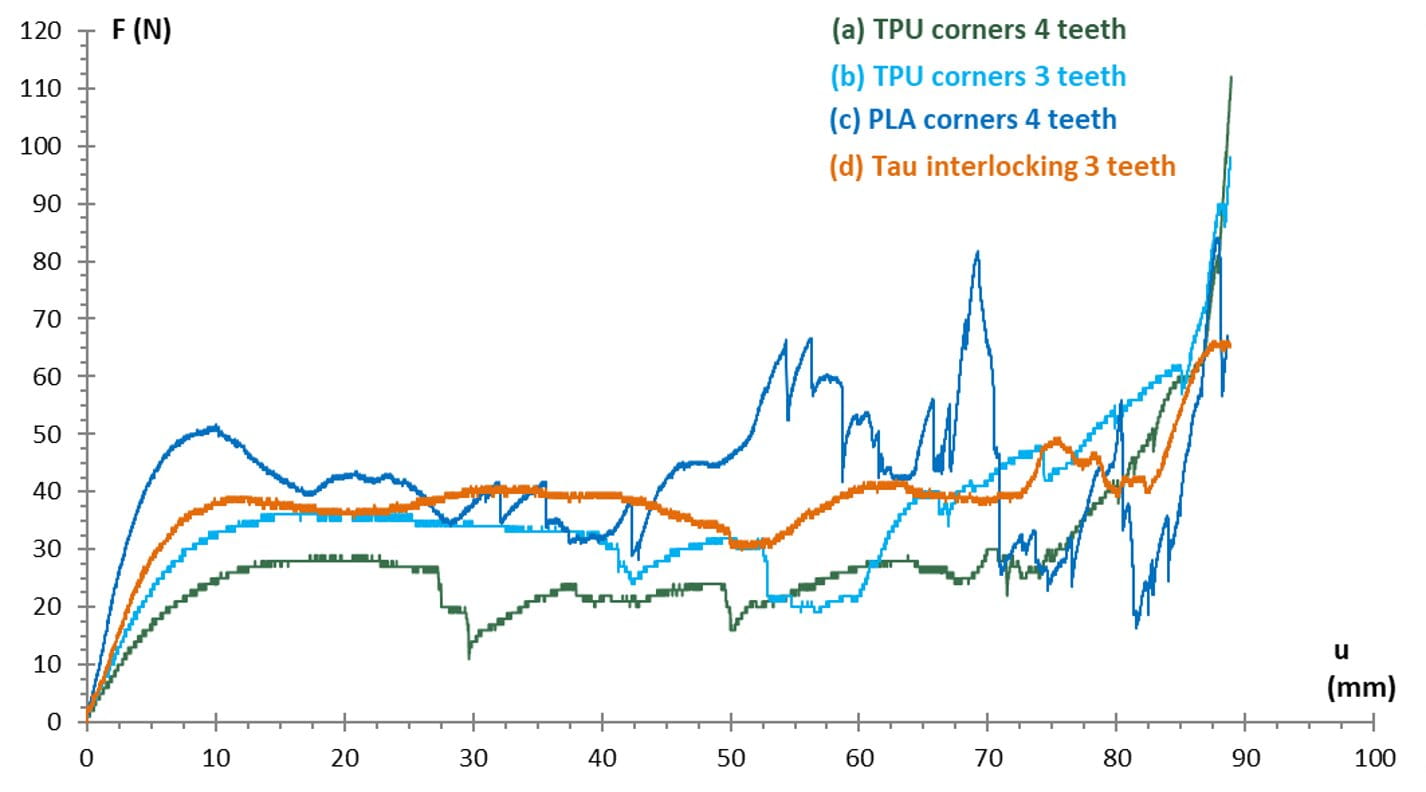
The force–displacement curves exhibit the characteristic response of cellular structures under compression, consisting of an initial elastic region, a progressive collapse plateau, and a final densification stage.
During the initial stage, all configurations show a rapid increase in force, corresponding to the elastic deformation of the cell walls. This is followed by a collapse region, where the force stabilizes or slightly decreases due to local buckling, node rotation, and progressive structural collapse.
The PLA-corners configuration reaches the highest peak force, indicating increased stiffness and load-carrying capacity. A significant drop in structural integrity is observed at approximately 50% strain, associated with damage accumulation and loss of stability.
The TPU-corners configurations present lower force levels and a more stable response. The 3-teeth configuration shows improved behavior compared to the 4-teeth case, with a smoother transition into the collapse regime and reduced fluctuations.
The tau interlocking configuration exhibits a distinct response, characterized by a stable plateau and reduced force fluctuations. Although the peak force is lower than that of the PLA-corners case, the deformation process remains uniform and controlled.
At large displacements, all configurations enter the densification stage, where contact between collapsed cell walls leads to a sharp increase in force.
Key observations:
• PLA interlocking: highest peak force with 4-teeth interlocking.
• TPU interlocking: lower strength (3-teeth) and outperforming (4-teeth).
• TPU Tau interlocking: lower peak force than PLA corners, but smoother and more stable post-elastic response.
Deformation evolution under compression
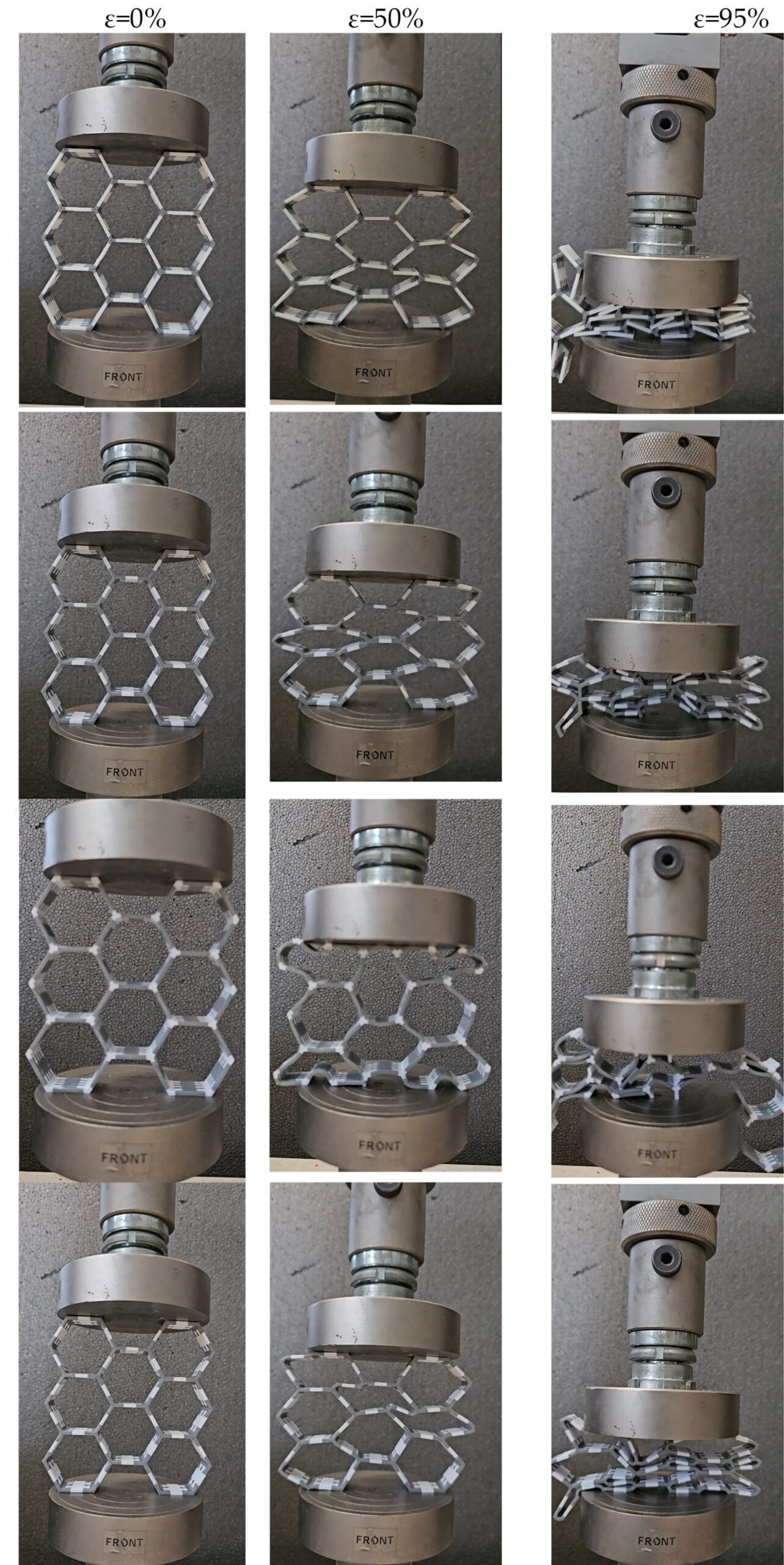
All configurations show three stages:
initial elastic response | collapse plateau | densification.
CONCLUSIONS
The compressive response of the examined honeycomb structures is governed by bending-dominated deformation mechanisms.
Material distribution directly affects the load-carrying capacity. Configurations with PLA at critical regions achieve higher peak forces and reduced deformation tolerance.
Interlocking geometry controls the evolution of deformation and the preservation of structural integrity. TPU-based configurations show more stable collapse behavior and improved deformation control.
The tau interlocking configuration combines stable load transfer, uniform deformation, and high resistance to structural degradation. Peak strength is lower compared to the PLA-corners case. Structural integrity is preserved over a wide deformation range.
The results indicate that optimal performance requires a balance between stiffness and flexibility, achieved through appropriate material placement and interfacial design.